Oven Repair
How to Calibrate a Gas Oven: Thermometer Test for Viking Owners
To calibrate a gas oven, average several thermometer readings at 350°F, then shift the oven's temperature offset by the gap and retest it.
- Published
- Read time
- 6 min
- Appliance
- Oven Repair
- Checked by
- Hollis Yamada
- Bench role
- Service technician — refrigeration and cooking
- At the bench
- 21 years in the trade
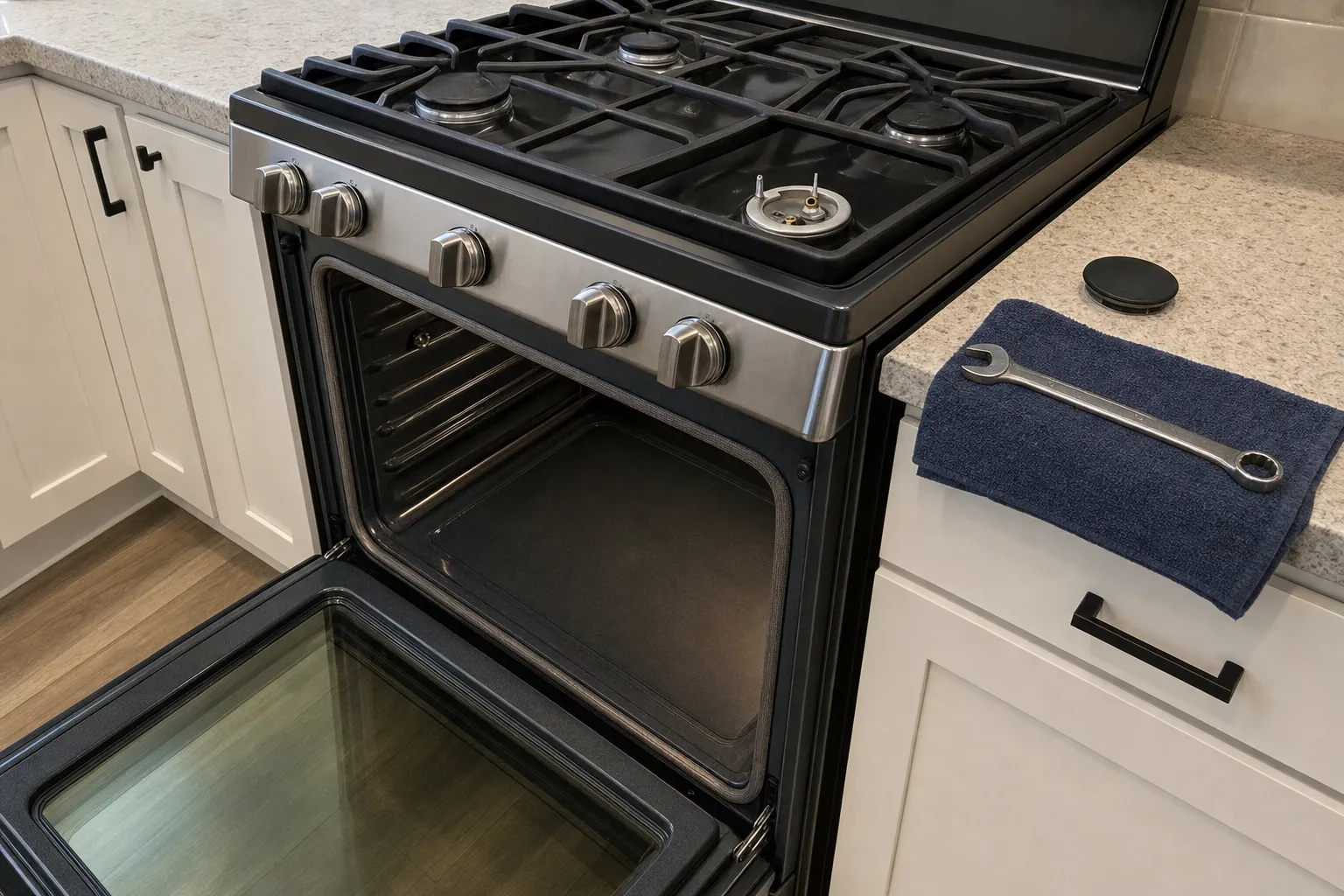
To calibrate a gas oven, first prove it is actually off. Set an oven thermometer on the middle rack, choose 350°F, let the oven run a full 20 minutes past its preheat signal, then read the thermometer four times about ten minutes apart and average the four numbers. If that average misses the setting by 25 degrees or more, enter the difference as a temperature offset, either in the settings menu of an electronic control or at the adjustment behind the knob on many older dial thermostats, and run the test again. A gas oven that still will not settle near its setting after one careful adjustment has a tired part, and turning the offset further only disguises it until the next bad batch of cookies.
Prove the thermometer before you trust it
An inexpensive oven thermometer can be wrong by itself, so check it before you blame the oven. The easiest reference is a digital probe thermometer. Dip the tip into a pot at a rolling boil and it should read very close to 212°F. Most of Redmond sits low enough, from the valley floor in Downtown Redmond up to the higher ground at Redmond Ridge, that water here boils within about a degree of that figure, so no altitude correction is needed.
A dial oven thermometer is not built to go into water, and most have no adjusting nut. Instead, set the verified probe beside it in the oven and compare them once both have settled. If the dial reads ten degrees high, note that and subtract it from every reading, or replace it. Only once your measuring tool is honest does the oven’s number mean anything.
Run the test the way a gas oven really heats
A gas oven never holds one steady temperature. The control lights the bake burner, lets the cavity climb a little past the setting, shuts the flame off, and lights it again once the air cools. On a Viking 5 Series gas range that burner is a single 30,000 BTU U-shaped tube beneath the oven floor, lit by the SureSpark ignition system, and its on-off rhythm shows up as a thermometer needle that rises and sinks. One glance only tells you where the oven is in that rhythm.
- Place the thermometer in the middle of the center rack, facing the window so you can read it without opening the door.
- Choose 350°F and let the oven announce that preheating is done. If you are unsure what that looks like on your model, here is how a Viking tells you it has finished preheating.
- Wait another 20 minutes so the walls and racks catch up with the air.
- Take four readings roughly ten minutes apart, opening the door as little as possible.
- Add the four together, divide by four, and compare the result with 350°F.
Write the numbers down. A spread of a couple of dozen degrees between the highest and lowest reading is ordinary for gas; the average is what you are judging.
Deciding whether an adjustment is worth it
| Average versus the setting | What it usually means | What to do |
|---|---|---|
| within about 15°F | normal burner cycling | leave it alone |
| 15–35°F, the same on each test | the control has drifted | set an offset, then retest |
| more than 35°F, or different each test | a sensor, thermostat or burner fault | stop adjusting and have it diagnosed |
Our short answer on how far off is too far off goes into what each band means for real cooking.
Setting the offset
Electronic controls
Ovens with a digital display usually keep the adjustment in a settings or options menu, where you nudge the oven’s sense of temperature up or down in small steps. If your test averaged 325°F at a 350°F setting, the oven runs 25 degrees cool, so you raise it by 25. The menu path changes between models and generations, so follow the owner’s manual for yours instead of pressing buttons until something happens. Our page on whether you can calibrate a Viking oven yourself explains what to expect from the procedure.
Dial thermostats
Older gas ovens with a mechanical thermostat often hide the adjustment on the back of the knob or on the shaft behind it: a tiny screw, or a ring with marks that turns a notch toward hotter or cooler. With the oven off and completely cold, pull the knob straight off and look before you touch anything. If you find nothing there, the thermostat has no adjustment, and replacing it is the fix.
Whichever kind you have, make one change, then repeat the full four-reading test the next day. An oven that follows the change and holds its new average is sorted. One that ignores the change, or obeys it and then wanders again within weeks, is pointing at a failing part.
When the number is right but the food is not
Many complaints that sound like calibration are really about where the heat lands. Viking’s own advice is that its gas ovens, with the Gourmet-Glo infrared broiler, do their best work broiling and baking on a single rack, while its electric ovens, built around the Vari-Speed Dual Flow convection system, are the better pick for several racks at once. Load three sheet pans into a gas cavity and the lowest tray will brown first however the thermostat is set. The 5 Series gas oven offers six rack positions; use a middle one for single-pan baking and leave room around the pan for air to move. Dark metal and glass bakeware also cook faster than shiny aluminum, which can pass for an oven running hot.
On a dual-fuel range the cooktop burns gas but the oven is electric, so this test still applies while the parts behind it differ. See which half of a dual-fuel Viking runs on gas if you are not sure what you own.
Signs that a part, not the setting, is at fault
- Preheating takes much longer than it used to, or the flame lights late and weak.
- The readings shifted right after a self-clean cycle, which on Viking self-cleaning ovens reaches up to 750°F.
- On a 7 Series range with backlit knobs, a knob ring glows red. Red means the control has logged an error; yellow only means self-clean is running.
- The average moves by a wide margin from one day to the next.
- You smell gas beyond the brief whiff at ignition. In that case turn the oven off, leave the house, and call your gas utility from outside.
Once the fault is found, typical ranges are $190–$480 for an oven thermostat or heating element, $180–$440 for an igniter or burner assembly, and $430–$650 for a control board or touch panel. Those are typical figures only; the firm quote comes after diagnosis. The $89 visit pays for the trip and a full diagnosis, and if you go ahead with the repair, that $89 is taken off its price.
Before you book a visit
Have the model and serial number to hand. On Viking 5 Series and 7 Series electric wall ovens an identification plate carries them, mounted high on the left edge of the door frame beneath the controls; for other models the manual shows where to look. Note your four readings, the temperature you tested at, and whether you already changed the offset. With that in front of them, a technician working in Downtown Redmond, Education Hill, Overlake or Redmond Ridge can tell much sooner whether the oven needs a part or just a better adjustment. Call (425) 585-2373 or use the booking button on this page.
Common follow-ups
What tells me a Viking oven has finished preheating?
The preheat signal means the air around the sensor has reached your setting, but the walls, floor and racks are still catching up. For baking that needs steady heat, and for any thermometer test, give the oven another 15 to 20 minutes after that signal before you trust the temperature inside.
Can I calibrate an electric oven the same way?
Yes, the thermometer test is the same on electric: center rack, 350°F, a long settle, several readings averaged. Viking 5 Series and 7 Series electric wall ovens accept settings from 200°F to 550°F, so 350°F sits comfortably inside their range. What differs is the part to suspect when an offset will not hold, usually the sensor or an element rather than a burner.
How far off is normal for a gas oven?
An average within roughly 15 degrees of the dial is normal for gas, because the burner keeps switching on and off and the air climbs and falls around the setting. One high or low reading proves nothing; judge the oven by the average of several readings taken after it has fully settled.
Does a self-clean cycle affect oven calibration?
It can. Viking self-cleaning ovens climb as high as 750°F to reduce baked-on soil to ash, and that much heat is hard on sensors, thermostats and the wiring behind them. If the readings change right after a clean, repeat the thermometer test once the oven is cold; a shift that stays points to a part, not the setting.
Is it safe to calibrate a gas oven myself?
Checking the temperature and changing a menu offset or a knob adjustment is safe for most homeowners. Stop at anything that means removing panels, reaching the burner or gas valve, or working near the supply line, and stop altogether if you smell gas beyond a brief whiff as the burner catches.